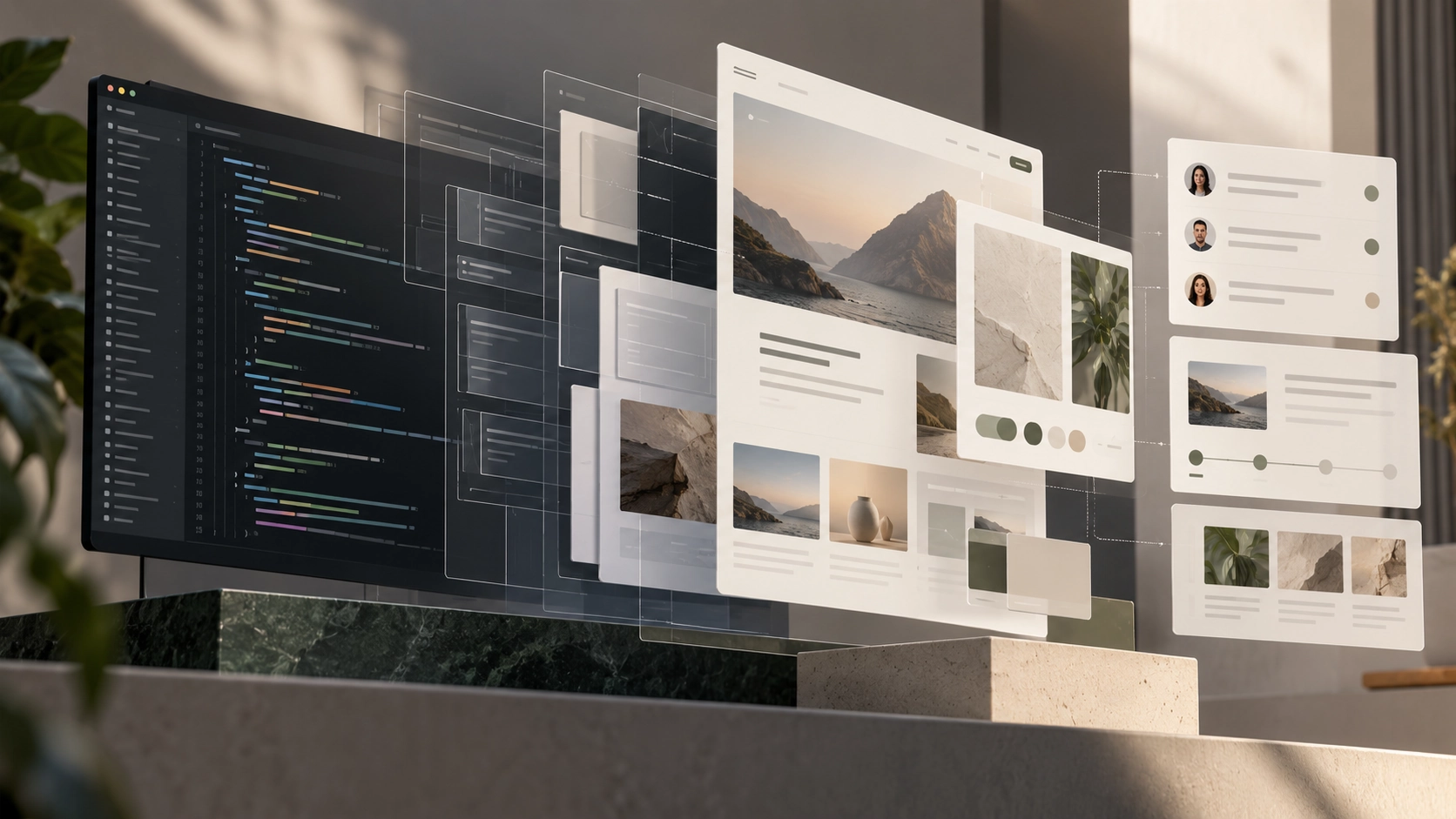

Webflow has announced Source, a platform where marketing teams and AI agents work on the same site through different interfaces, with code rather than a visual abstraction as the foundation. It is currently a limited research preview with no published pricing or release date, so the useful question is not whether to adopt it but what it signals about where design and agency work is heading.
Key Takeaways
- Source makes code the foundation for everything that ships, which removes the abstraction layer agents previously had to work through.
- Views give each person a workspace shaped around the job they own, with permissions and approval paths built in.
- Governance is the quieter and more consequential part of the announcement, not the agent capability.
- For agencies, the notable change is being able to work on a client's existing codebase without asking them to migrate first.
- It is a research preview with no pricing or availability date, so treat it as a signal rather than a plan for this quarter.
Most platform announcements are worth a skim and little else. This one is worth reading properly, not because of what it does today, but because of what it says about the assumption the whole category was built on.
Webflow has spent a decade arguing that non-developers need a visual layer standing between them and production code. Source reverses that position. Code becomes the thing that ships, the visual canvas writes to it, and agents operate on it directly. That is a genuine change of mind from the company that made the visual builder mainstream, and it revisits a question we looked at a while ago about the future of web design.
What Webflow actually announced
Webflow unveiled Source at its 2026 conference in early September. The company describes it as a platform where marketing teams and their agents launch, optimise and scale digital experiences together, connecting an existing codebase and marketing stack into one environment.
Three things sit at the centre of it. Code is the foundation for everything that ships, so agents can make larger changes without working through an abstraction layer, while the visual canvas remains available for the precise work and writes to that same code. Views are a new way to shape a workspace around a specific job, whether that is site building, campaigns, content or optimisation. And the whole thing is composable, meaning you can connect your own codebase, CMS, hosting and marketing tools, including sites already built in Webflow, rather than migrating everything across.
The detail that matters most for planning purposes is the status. Source is a limited research preview, with selected agency partners and customers being enrolled in phases. There is no published pricing and no general availability date. Webflow has also said the existing platform is not going anywhere and that a supported migration path will exist if you choose to move later. You can read the full Source announcement for the company's own framing.
The real shift: code as the source of truth
Strip away the agent language and the structural change is this. In the Webflow most people use, what you build in the Designer and what reaches the browser are related but not identical. The abstraction layer has always cost something, and Webflow has now said so publicly in its reasoning behind Source.
Removing that layer matters for a practical reason. Code is what AI systems actually understand. An agent working against a visual abstraction is guessing at the relationship between what it changes and what ships. An agent working directly on code can read the whole system, change it and check its own work. That is the difference between an assistant that drafts suggestions and one that can be trusted with a real task.

It also changes what expertise is worth. If generating a page becomes trivial, the value moves to the decisions a generator cannot make well: information architecture, content modelling, performance, integrations and the judgement about what should exist at all. Anyone whose value rests mainly on moving quickly inside the Designer should read that carefully. This is the same argument we made about the limits of the no-code approach, arriving from an unexpected direction.
Views, and why governance is the quiet headline
The agent features will get the attention. The governance model is the part that determines whether any of this works at scale.
Views let a team give each person an interface shaped around what they actually own. A content marketer does not need the full canvas. A designer does not need the campaign tooling. Webflow has paired that with role-based access, approval paths, brand systems and audit trails, and says teams decide how much autonomy agents get, from requiring sign-off before anything ships to letting agents act freely on lower-risk work. Agent actions are governed by the same permissions as human ones, with a record of what changed and who or what changed it.
Anyone who has watched an enthusiastic stakeholder loose in a CMS will recognise why this matters. The constraint on giving more people access to a website has never been the interface. It has been the absence of a safe way to let them touch it. Applying the same logic to agents is the sensible move, and it is why a documented brand system stops being a nice-to-have. If agents ship work against your brand rules, those rules need to exist somewhere more durable than a designer's instinct.
What this could mean for web designers
The honest reading is that some work gets commoditised and some becomes more valuable, and the split is fairly predictable.
Production work is the exposed category. Building a variant of an existing layout, adapting a section, resizing and restyling: these are exactly the tasks a capable agent working on real code should handle. If that is the bulk of what you do, the next few years will be uncomfortable.
What becomes more valuable is everything upstream and everything requiring judgement. Defining the design system that agents work within. Deciding what a page needs to accomplish and for whom. Content structure and information architecture. The last ten per cent of craft that separates a competent page from a memorable one. Knowing when the generated answer is wrong.
There is a reasonable objection here, which is that we have heard this before. Every tool that promised to eliminate design work has instead shifted it. That is probably true again. The prudent position is neither panic nor dismissal: assume the production floor shrinks, and make sure your value sits somewhere else. Our own view of web design has always treated the system and the strategy as the work, with the pixels as the output rather than the point.
What this could mean for agencies
Webflow was unusually direct about the agency opportunity, and three points are worth taking seriously.
The first is reach. Because Source works with real code and an existing stack, the constraint that a client had to be willing to move to Webflow CMS goes away. That is a meaningful change to the addressable market for any Webflow-focused agency. Projects previously declined or handed to a specialist development shop become deliverable in-house.
The second is productisation. Webflow describes building a custom View around how a client's team works, then publishing it and installing it on other projects in much the same way you would install an app. For agencies that have spent years rebuilding the same workflows for every client without ever owning them, that is a genuinely different commercial model: something reusable rather than something re-delivered.
The third is advisory positioning. Clients are already asking their agencies about AI, usually without a clear question. Having a platform to point at turns a vague conversation into a service you can scope and charge for.
Worth noting what none of that changes. Someone still has to decide what the site should say, how it should be structured and what good looks like. Across our client work, including companies like HockeyStack, a previous client, the value was never really in who moved the elements. It was the thinking behind them, and no agent takes that over.
What we do not know yet
Being clear about the gaps is more useful than speculating past them.
There is no pricing and no general availability date. Access is limited to selected partners and customers in a phased rollout. We do not know how well agents handle genuinely complex work such as a full rebrand or a large migration, as opposed to the contained tasks that demo well. We do not know how deep the permission model goes in large organisations, or how the developer experience works in practice around real repositories and version control. And we do not know how much of the current shape survives the preview, which is the entire point of calling it a research preview.
Anyone presenting Source as a settled fact right now is ahead of the evidence. It is a credible direction from a company with the resources to pursue it, announced early, with the important commercial details still missing.
What to do about it now
Very little urgently, and a few things deliberately.
Keep building. The existing platform is not being retired, and Webflow has committed to a supported path if you migrate later. Nothing about a research preview justifies pausing work, and Webflow development done well today will not be wasted.
Document your design system properly, if that has been on the list for a while. Any future in which agents ship work depends entirely on the rules being written down. The same applies to content structure: a coherent model is what lets anything, human or otherwise, produce sensible pages at volume.
Watch the agentic features already shipping in the current platform rather than waiting for Source. The AEO agents and the MCP work are available now, and they are a reasonable preview of how this feels in practice. If search visibility is the pressure point, that overlaps directly with SEO services and is worth attention regardless of what Source becomes.
And if you want to be in the preview, apply through the Source research preview page rather than waiting to be invited.
Frequently asked questions
1. Is Source available to use now?
Not generally. It is a limited research preview, with selected agency partners and customers enrolled in phases over the coming months. Webflow has not published pricing or a general availability date, so it cannot reasonably be built into a current-quarter plan.
2. Does Source replace the Webflow we use today?
No. Webflow has said the existing platform continues and will keep receiving investment, including further agentic capability. If you choose to move to Source later, the company has committed to providing a supported path, but nothing forces that decision now.
3. Will Source make web designers unnecessary?
It is more likely to shift what designers are paid for than to remove the role. Repetitive production work is the exposed part. Design systems, information architecture, content structure, judgement about what should exist and the final quality pass all become more valuable when generating a page is cheap.
4. What does Source change for agencies specifically?
Three things. It removes the requirement that a client migrate to Webflow CMS before you can work with them, which widens the addressable market. It allows agency workflows to be built as reusable Views rather than rebuilt per project. And it gives agencies a concrete platform to anchor AI advisory work that clients are already asking about.
5. Should we change our platform plans because of this announcement?
No. A research preview with no pricing and no release date is not a basis for changing direction. The sensible response is preparation rather than reaction: document your design system, tidy your content model and keep shipping on the platform as it exists today.
Final word
The interesting part of this announcement is not that AI can build websites, which stopped being news some time ago. It is that Webflow has publicly abandoned the assumption its own product was built on, and decided the abstraction layer costs more than it gives once agents are involved. Whether Source succeeds is genuinely open. The direction it points in looks harder to argue with: the work that lasts is the structure, the system and the judgement, not the act of assembling a page. That has been true for a while, and this is a fairly loud confirmation of it. If you are weighing what it means for your own site or your own team, get in touch and we will give you a straight read.