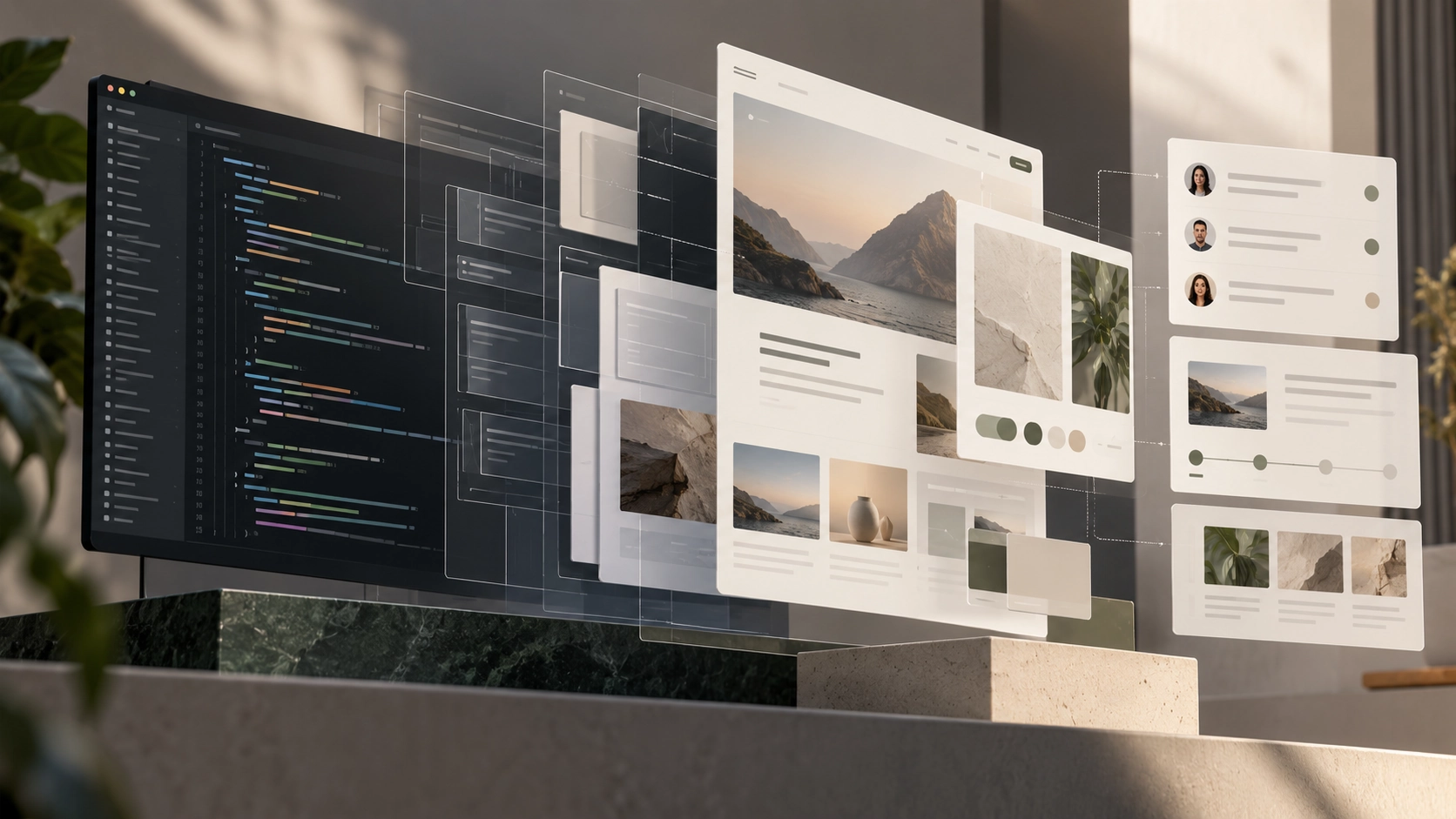

A YC startup website often works well for Demo Day but becomes less effective as the product, buyer and sales process mature. The next stage needs a modular site that explains the product in greater depth, supports buyer evaluation, builds credibility beyond the YC badge and lets marketing publish without relying on engineering.
Key Takeaways
- A Demo Day website serves a compressed investor story, while post-batch buyers need detail on fit, value, risk and implementation.
- The website should evolve when the product, ideal customer and sales narrative have moved beyond the original launch positioning.
- Authentic product visuals, workflow explanations, use cases and technical detail make complex products easier to understand.
- A well-structured Webflow system gives marketing controlled autonomy through reusable components, CMS collections and modular page patterns.
- Treating the website as an ongoing product keeps it in step with launches, repositioning and changing buyer expectations.
Your website did its job. During the batch it explained the idea, opened the waitlist and gave Demo Day a clean place to point. That was the right site for that moment. The trouble starts later, when the product has grown, the buyer has changed and the sales calls have moved on, but the site still reads like the pitch you gave to a room of investors.
This is the quiet problem most YC graduates run into. The early site is not amateur work. It is optimised for speed and a compressed public story, and it stops serving you when the company underneath it has become something bigger. This article is about what changes after the batch, why the website has to carry a wider load, and how a modular Webflow system turns what you learned by hand into a marketing engine that teaches buyers at scale.
The website you built during YC has a different job now
Y Combinator describes its programme as an intensive stretch designed to leave a company with a better product, more users and stronger fundraising options. The pressure during those weeks is on doing, not documenting, and the website reflects that: it says what the product is, who it helps and what to do next, and it does so quickly.
Nothing about that is wrong. The early site only needs to explain the central idea and create one obvious next step. The gap opens once the audience widens. After the batch your site is read by customers running a real evaluation, later-stage investors doing diligence, candidates, partners weighing an integration and technical evaluators who want to understand how it works. That is a longer buying journey than a launch page was built to hold. This is about changing requirements, not growing up: the structure that made the site fast at Demo Day is what makes it slow now. You can read what happens at YC for the official view of what the programme is designed to produce.
Move from a pitch to a complete buyer narrative
A Demo Day story is compressed on purpose. You have a short window and a specific audience, so you cut everything inessential and lead with the sharpest version of the idea. That compression is a strength in the room and a weakness on a website a buyer visits alone, at their own pace, deciding whether to trust you with a budget.
Buyers need enough depth to make that call. The goal is to keep the sharpness of the pitch and add what is required to judge fit, value and risk: who the product is for, the problem and why it matters now, how it works, the use cases and workflows, what makes it different, the proof, the integrations and implementation, and any security or compliance detail the people signing off will want. It ends with a conversion path suited to the reader's stage.
The mistake to avoid is treating investor and buyer messaging as interchangeable. An investor wants the market, the wedge and the trajectory. A buyer wants to know whether this solves their problem without creating three new ones. Both can live on the same site, but the homepage should not try to be both at the same volume. This is where a product-led web design approach earns its keep, giving a technical buyer room to go deep on a workflow while keeping the first screen clean for someone who arrived thirty seconds ago.
Make an evolving technical product understandable
Many YC companies are not competing inside a familiar category. They are creating one, which is a communication problem, because a reader cannot slot you into a shelf they already own. The website has to make a sophisticated product tangible without collapsing it into a vague "AI-powered" line that tells the reader nothing.
The reliable pattern is to lead with a problem the reader recognises and an outcome they want, then layer the technical depth underneath. Use authentic product UI, workflow diagrams, architecture explanations and integration maps where they clarify rather than decorate, and anchor each capability to a use case backed by customer evidence. Give business and technical evaluators different depths of the same truth without forcing every detail onto the homepage.
Phonely, an S24 company we previously supported, illustrates the problem. A voice-AI product carries real infrastructure underneath it, and the site has to translate that into business value, trust and a buying journey a non-technical evaluator can follow, without stripping out the detail an engineer will look for. Browse the YC startup directory and you can see how varied the challenge is. Some companies sell a clear improvement on a known tool; others explain a workflow their buyer did not know was possible last year. The second group needs a site that teaches, and teaching well is a structure problem before it is a copy problem. Getting the Webflow development right keeps a complex product understandable as it changes.
Use Webflow as a marketing operating system
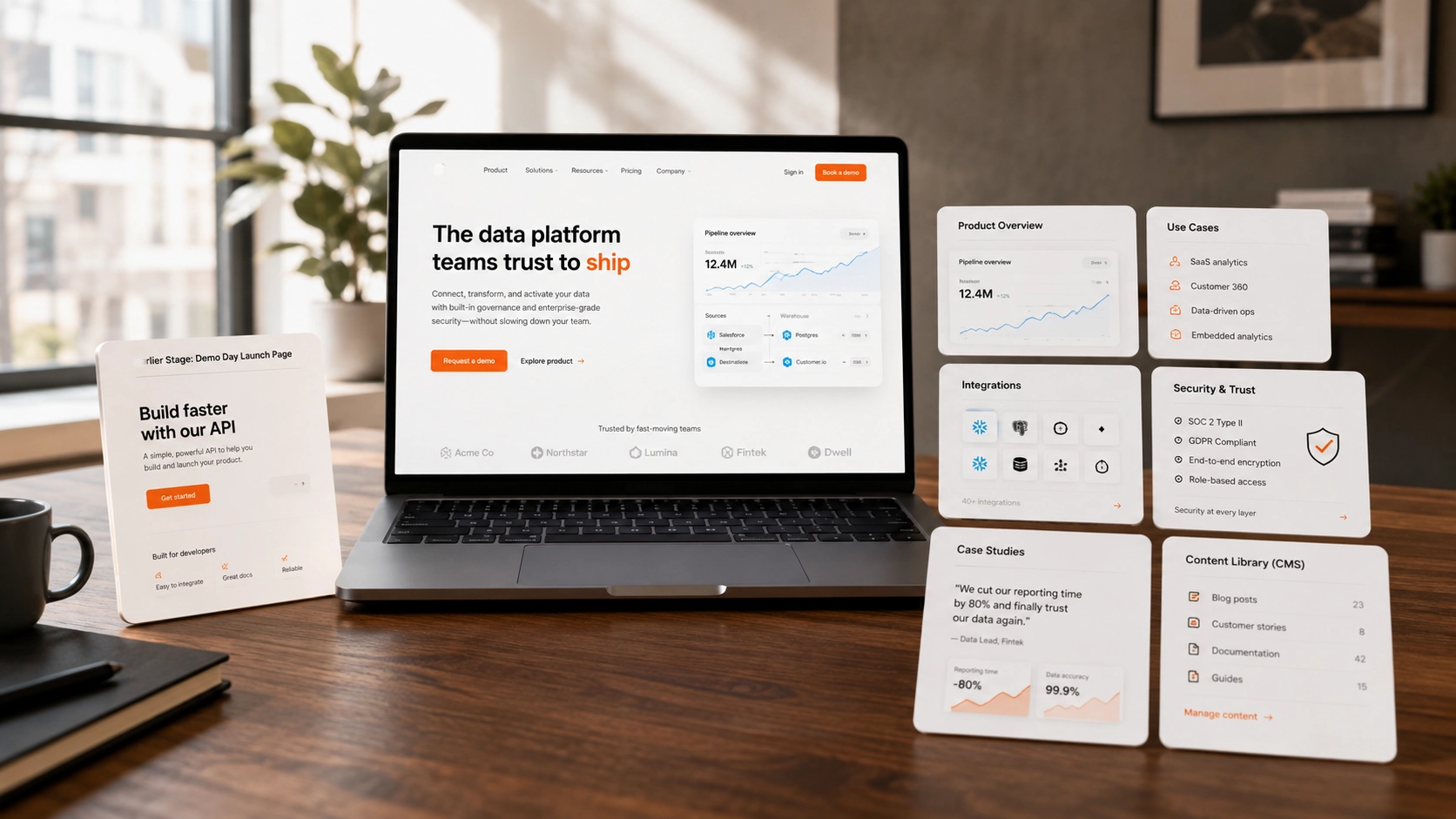
It is tempting to reach for Webflow because no-code feels faster. Faster is real, but the stronger argument is that a well-designed system gives marketing controlled autonomy while keeping the brand and structure consistent. That autonomy comes from how the system is built, not the platform on its own. Reusable components mean a new page inherits the design decisions you already made. Structured Webflow CMS collections let you manage case studies, integrations and job listings as data, so adding the tenth takes minutes rather than a fresh build. Modular page patterns let a marketer assemble a campaign page from parts that already match the brand, custom interactions add polish, and clear governance keeps the whole thing from drifting as the team grows. Routine marketing work stops queueing behind product engineering.
The honest caveat is that Webflow is not automatically right for every company. Its value depends on a thoughtful information architecture, a real design system and build quality. A poorly structured Webflow site is as much of a bottleneck as the thing it replaced.
Treat the website as an ongoing product, not a one-time project
The redesign mindset is the enemy here. If you rebuild the site every eighteen months and ignore it in between, it will always lag behind the company. Product launches, new customer evidence, market shifts and the demands of moving upmarket arrive continuously, and they should feed into the site as they happen rather than piling up until the next rebuild.
This is the operating model we run with clients on retainer. Ergo, a W25 company we currently work with, is the clearest example: an ongoing partnership rather than a single delivery, covering strategy, design evolution, new pages, campaign work, messaging changes and Webflow development as the product and go-to-market story move. When positioning sharpens or a capability ships, the site moves with it.
We have run substantial engagements across several YC batches. HockeyStack, an S23 company we previously supported, is a useful growth-stage example: a story that started around a narrow attribution proposition expanded into a broader product for enterprise buyers, and the marketing system had to grow with it. Vellum, a W23 company we also previously supported, shows how fast positioning can move, its public story now spanning production LLM applications, workflows and agents. Gauge, an S24 company we likewise supported previously, faced a related problem in a market where organic, paid and AI search keep redrawing the category, which makes plain category clarity unusually valuable. A site built as a living product absorbs that kind of change; one built as a finished artefact has to be torn down to accommodate it.
Build credibility that stands beyond the YC badge
The YC affiliation is a real asset that helps you get noticed and discovered, but it should not be the whole of your credibility. The badge is one trust signal, and a strong post-batch site turns it into one signal inside a broader system that makes the product persuasive on its own terms.
That system is made of concrete things: customer logos a prospect recognises, outcome-led case studies showing what changed rather than just who bought, product demonstrations, and the security and privacy information the people whose job is to say no will look for. Integration and implementation detail, leadership content and hiring pages together signal a real company rather than a promising demo. The aim is not to hide where you came from, but to make the product stand up for a reader who has never heard of the accelerator.
Delve, a company that came through YC's W24 batch and that we previously supported, illustrates the difference between a launch story and a durable credibility system. A site carrying real proof, clear product explanation and enterprise-grade trust content does work a badge alone cannot. A coherent visual identity matters too, because credibility is partly a design impression formed before anyone reads a word.
A practical diagnostic: have you outgrown your website?
Not every YC graduate needs a large site the week the batch ends. The point is to recognise the moment your current one has quietly become a constraint, and a few signals tend to appear together. The homepage still leads with Demo Day language that meant something to investors and little to a buyer. Sales keeps explaining, call after call, what the site should clarify on its own. Marketing is blocked because every change needs an engineer. Landing pages have accumulated as disconnected one-offs that no longer look like the same company. The product is barely visible, hidden behind abstract copy. The messaging has drifted into generic "AI" language that could describe a hundred other companies. Enterprise buyers cannot find the security, compliance or implementation content they need. And every positioning shift prompts someone to mutter that the whole site needs rebuilding.
If several of those are true at once, the site is no longer helping you grow. It is quietly taxing every other part of the business, and that is the signal to move toward a system that can keep up.
What a Webflow partner actually adds, and where to start
Access to Webflow is not the differentiator. Anyone can open the platform. What matters after the batch is combining senior strategy, product storytelling, visual design, animation and maintainable Webflow development at startup speed rather than agency pace, built as a modular system rather than a pile of isolated pages. That is why one small, senior team can support a company through a repositioning, a launch and a fundraising push without a new statement of work every time. For a practical starting point, read our take on whether Webflow is the future of web design.
The most useful thing a founder can do now is honest triage. Read your own site as a first-time buyer. Does it describe the company you presented at Demo Day, or the company you are building now? Could a buyer evaluate you without a sales call? Could your team ship a page this week without waiting on an engineer? If the answers make you wince, the site has drifted behind the business, and the fix is not always a full rebuild. Sometimes it is a focused review and targeted changes to the pages carrying the most weight. For a second read on where yours sits, get in touch.
Frequently asked questions
1. When should a YC startup redesign its website after the batch?
There is no fixed date. The right time is when the signals appear together: Demo Day language on the homepage, sales repeatedly explaining what the site should clarify, marketing blocked by engineering, disconnected landing pages, weak product visibility and missing trust content for enterprise buyers.
2. Why is Webflow a good fit for post-Demo Day startup websites?
A well-built Webflow system gives marketing controlled autonomy. Reusable components, structured CMS collections and modular page patterns let the team ship pages and campaigns without an engineering dependency, while keeping the brand consistent. The value comes from information architecture and build quality, not no-code on its own.
3. Is a YC affiliation enough to build trust with buyers?
It helps, but it is one signal rather than the whole picture. Buyers, later-stage investors and procurement teams look for outcome-led case studies, product demonstrations, security and compliance detail, integrations and implementation content. The badge attracts attention; the rest of the site has to make the product persuasive on its own terms.
4. How is investor messaging different from buyer messaging on a website?
Investor messaging is built for a compressed moment and focuses on market size, the wedge and the trajectory. Buyer messaging supports a longer, self-guided evaluation covering fit, value, risk, workflows, proof and implementation. Both can live on the same site, but not at the same volume on the homepage.
5. Does every YC graduate need a large website right away?
No. Plenty of early-stage companies are well served by a lean site for a while. The point is to recognise the moment the current one starts taxing sales, marketing and credibility, and to move deliberately then.
Final word
The website you launched during YC was the right tool for a specific job. Growing past it is not a sign the early work was poor. It is a sign the company underneath it has changed. The strongest post-batch site takes what you learned by hand, the buyer language, the objections, the use cases and the proof, and turns it into a system that teaches prospects at scale. Build it as a living product, keep it moving with the company, and it stops being the thing you dread rebuilding.